
Guide/Chapter III
Safety
Zero risk does not exist. This page sets out, practice by practice, what can go wrong, how to make it less likely and when to stop.
In this chapter
Reducing risk, not promising safety
The acronym SSC (Safe, Sane, Consensual) promised a “safe” and “sane” practice. RACK, for Risk-Aware Consensual Kink, arose in response to how vague those two words are: rather than claiming that it is free of danger, you commit to knowing the risk and choosing it together. The Rope Bottom Guide, written for people who are tied, says so from the outset: every tie carries a risk, even in experienced hands1. This page therefore aims at something modest and useful: making accidents less likely, spotting them early and knowing what to do.
Preparing the scene
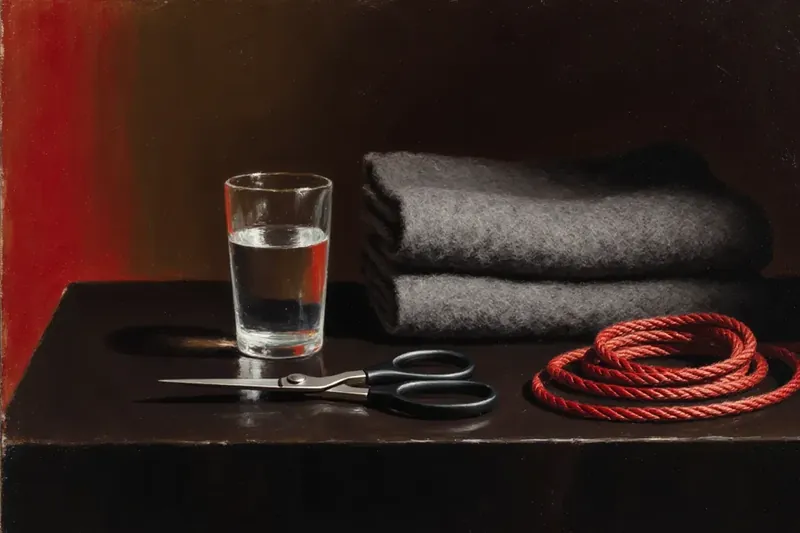
Before a scene, the moment of play itself, prepare the room on the assumption that something may go wrong. Within reach, not in the drawer next door:
- round-tipped safety shears that genuinely cut what you are using;
- water;
- a blanket, because people often feel cold after a session1;
- a charged phone.
Knowing the other person’s health
This is part of negotiation, not prying. What matters: heart conditions and pacemakers, breathing problems, nerves already affected, reduced mobility, psychological vulnerabilities1, but also epilepsy, diabetes, old shoulder, wrist or back injuries, and any current treatment. An anticoagulant, for example, makes bleeding and large bruises more likely2: impact is then no longer negotiated in the same way. The question applies both ways, including to the person doing the acting.
Never under the influence of alcohol or drugs
Santé publique France makes the point: you need to be able to feel when pain becomes excessive, and drugs do not always allow that3. Alcohol also blurs consent. In 2005, the European Court of Human Rights upheld the conviction of two men who drank heavily during sessions and had carried on despite their partner saying “stop”: the partner’s initial agreement did not cover what followed4.
Red flags and green flags
Safety begins before the first scene, with the choice of the person you play with. Limit violations are not rare: in an online survey of 4,503 practitioners by the National Coalition for Sexual Freedom, 29% said they had already had a negotiated limit or their safeword, the word agreed on for stopping, ignored5. The sample is not representative, but the order of magnitude is a reason to look at how a person approaches play. People talk about red flags, warning signs, and green flags, reassuring signs. One sign on its own proves nothing; several together do. These signs also apply to any new encounter, BDSM or not. In the lists below, “they” refers to the person you are thinking of playing with, whatever their gender.
Red flags
- They want to go fast: no discussion, a first meeting straight away in private, an intense scene the very first time.
- They brush your limits aside: “a real submissive doesn’t have any”, “you’ll see, you’ll like it”.
- They refuse a safeword, make fun of it or present it as something for beginners.
- They refuse a meeting in a public place, a safe call, or the people close to you knowing where you are.
- They cut you off from your friends or from the community, or run down the people who warn you.
- They suggest playing after drinking or taking drugs.
- They do not keep small agreements (times, messages, photos): the big ones will not be kept any better.
- They say they are very experienced but nobody knows them, or all their exes are “crazy”.
- They demand intimate photos, especially with your face, or hint that they could show them to others.
- The dominance spills over the agreed framework and reaches into your money, your work or your relationships.
Green flags
- They ask about your desires, your limits and your health, and they listen to the answers.
- They suggest a safeword and a stop gesture of their own accord, and check that you both understand them the same way.
- They accept a no without insisting, and a “not yet” without counting the days.
- They start small and suggest taking stock afterwards.
- They talk about aftercare, the care after the scene, and check in on you the next day.
- They acknowledge their mistakes and also talk about their own limits.
- They go to munches (informal get-togethers in a café) or workshops, other people know them, and they have nothing against you talking about it.
- They respect your life outside play.
Practice by practice
Impact
The risk: striking where organs, bones or nerves lie close to the surface. Fleshy areas can take it: the buttocks, the upper thighs, the upper back while avoiding the shoulder blades. Avoid the kidneys, the spine, the back of the neck, the joints, the belly and the face. Start gently, build up in stages, watch the skin. Stop if the pain changes in nature (sharp, deep, “not the right kind”), if the skin breaks when that was not planned, or if answers become vague.
Wax
The risk is burns: not all candles melt at the same temperature. Use low-temperature candles made for this purpose (paraffin or soy). Test first on your own forearm, keep a sufficient drop height and only come closer gradually. Never on mucous membranes or the face. Stop if the skin blisters or stays bright red. Fire play, for its part, can only be learned in a workshop: no technique here.
Ice and temperature
An ice cube sliding over the skin poses few problems. An ice cube or a cold pack left in place, on the other hand, can cause a cold burn. Wrap packs in cloth, and keep dry ice away from the skin6. On the hot side, the same rules apply as for wax: test on yourself, leave nothing in place. Stop if the skin turns pale or greyish, if tingling gives way to numbness, or if a blister appears6.
Electricity
Only with devices designed for use on the body. Never above the waist with a device that is not intended for it, never across the chest, and not at all if a pacemaker is involved. Even for medical nerve stimulation devices (TENS), the British health service rules out the neck, simultaneous use on the chest and back, and people who have a pacemaker or epilepsy7. Stop at the first sign of feeling unwell, at the slightest palpitation, or if the skin heats up under an electrode.
Clamps
A clamp crushes a small volume of tissue and slows the circulation there. The longer it stays on, the more the area suffers, and removal is often sharper than application, as the blood returns. Choose adjustable clamps, start with little pressure, never use them on damaged skin, and treat removal as a part of the scene in its own right, announced and accompanied. Stop if the area turns white and cold, or if the pain keeps rising instead of levelling off.
Gags and sensory deprivation
As soon as speech is prevented, a non-verbal signal is mandatory, agreed beforehand and tested: dropping an object held in the hand, tapping three times, grunting an agreed rhythm. A gag means that all breathing goes through the nose. A cold, an allergy or tears therefore change everything, and nothing must cover the nose. If nausea sets in, the gag comes out immediately. Blindfolds, headphones and earplugs take away points of reference: stay in contact, by voice or by touch. Stop at the first sign of breathing difficulty, panic or nausea.
Needles and blades
No technique here: this is learned in a workshop, in person, with someone who demonstrates and corrects. The principles are not negotiable: sterile single-use equipment, a sharps container, never along the path of a blood vessel or a nerve. Stop if bleeding does not respond to pressure or if the person feels faint.
Psychological play and humiliation
No visible mark does not mean no risk. A word can press on a real wound (the body, someone’s origins, their past), and the damage sometimes only shows the next day. Negotiate themes and off-limits words, not just practices: the portrait helps you set them out. The stop signal applies to words too. Plan a debriefing with a cool head, the next day or the day after: what hit home, what hurt. Stop when the person freezes, answers mechanically or seems somewhere else. They may no longer be able to say stop.
Remote and solo play
An instruction given remotely, by message or with the game cards, leaves the person carrying it out alone with the risk. Self-bondage, tying yourself up, is the most dangerous solo practice. The rule is not up for debate: when you are alone, never use a tie you cannot get out of by yourself, and never put anything around your neck or anything that restricts breathing. Forensic medicine knows the outcome when the neck, breathing and being alone are combined: a review of 408 autoerotic deaths published between 1954 and 2004 shows that they were mostly accidental asphyxiations8. Remotely, add a check-in: “reply within ten minutes”. If there is no reply, the person who gave the instruction calls, then alerts someone who can come round, or the emergency services. That means they need to know your address.
Rope
The most serious risk concerns the nerves more than the circulation1. In a series of ten people injured during suspensions, the radial nerve, in the middle of the upper arm, was affected in nine of them9. Shears within reach, regular hand and wrist checks, and suspension is learned in person. Everything is detailed in Rope and nerves.
Breathing
There is no safe way to squeeze a neck10. Loss of consciousness can occur within seconds, injuries are not always visible, and a stroke can occur days later11. This site gives no technique, whether “less risky” or otherwise. The Breathing and strangulation page explains why, and what you can do instead.
Afterwards: aftercare and drop
A scene does not end when the last knot is undone. Aftercare is the care that follows: water, a blanket, contact, a few words. It concerns both roles. The drop, the low that can follow, sometimes comes straight away and sometimes several days later12. Check in on each other the next day. The details are in Body.
When to call the emergency services
Call without waiting in case of loss of consciousness, even brief, difficulty breathing, chest pain, or numbness or weakness that persists once the person has been untied.
In Switzerland, 112 also works, even with a foreign SIM card13.
Going further
- Rope and nerves: the nerves to protect, the checks to do during the session and what to do if a sign appears.
- Breathing and strangulation: why the neck stays off limits, and how to play with surrender in other ways.
- Tonight: taking stock of how you are today before a session, tiredness and health included.
- Body: what the body goes through during and after a scene, aftercare and drop included.
Sources
-
Clover, 2020. The Rope Bottom Guide, French version (translated by Docvale), v4.2. Self-published. link ↑↑↑↑↑
-
NHS, 2024. Anticoagulant medicines, side effects. National Health Service (United Kingdom). link ↑
-
Santé publique France, n.d. BDSM entre hommes : attache-moi ! Sexosafe. link ↑
-
European Court of Human Rights, 2005. K.A. et A.D. c. Belgique, applications nos. 42758/98 and 45558/99, judgment of 17 February 2005. HUDOC. link ↑
-
National Coalition for Sexual Freedom, 2014. Consent Violations Survey, online survey of 4,503 people. NCSF. link ↑
-
Cleveland Clinic, 2026. Ice Burn Treatment & First Aid. Cleveland Clinic. link ↑↑
-
NHS 111 Wales, n.d. TENS (Transcutaneous electrical nerve stimulation). NHS 111 Wales. link ↑
-
Sauvageau, A. and Racette, S., 2006. Autoerotic deaths in the literature from 1954 to 2004: a review. Journal of Forensic Sciences, 51(1), 140-146. link ↑
-
Khodulev, V., Klimko, A., Charnenka, N., Zharko, M. and Khoduleva, H., 2023. Acute Radial Compressive Neuropathy: The Most Common Injury Induced by Japanese Rope Bondage. Cureus, 15(5), e39588. link ↑
-
Backal, N., 2024. Sex and strangulation: Dr. Debby Herbenick speaks at RSVP Center event. Student Life (Washington University in St. Louis). link ↑
-
Victoire, A., De Boos, J. and Lynch, J. M., 2022. ‘I thought I was about to die’: Management of non-fatal strangulation in general practice. Australian Journal of General Practice, 51(11). link ↑
-
Sprott, R. and Randall, A., 2016. Black and blues: Sub drop, top drop, event drop and scene drop. Journal of Positive Sexuality, 2(3), 53-61. link ↑
-
Confédération suisse et cantons, n.d. Urgences et dangers. ch.ch. link ↑↑
-
Direction de l’information légale et administrative, 2024. Le 0 800 112 112 : un numéro qui vous rappelle en cas d’urgence. Service-Public.fr. link ↑
-
SPF Intérieur, n.d. Il y a toujours quelqu’un pour vous aider en cas de besoin. 112.be. link ↑
-
Gouvernement du Québec, n.d. Quand et comment utiliser le 911 au Québec. Québec.ca. link ↑