
Rope and nerves
Rope mostly damages nerves, often without warning. Here is where they run, how to check during a session that they are fine, and what to do when they are not.
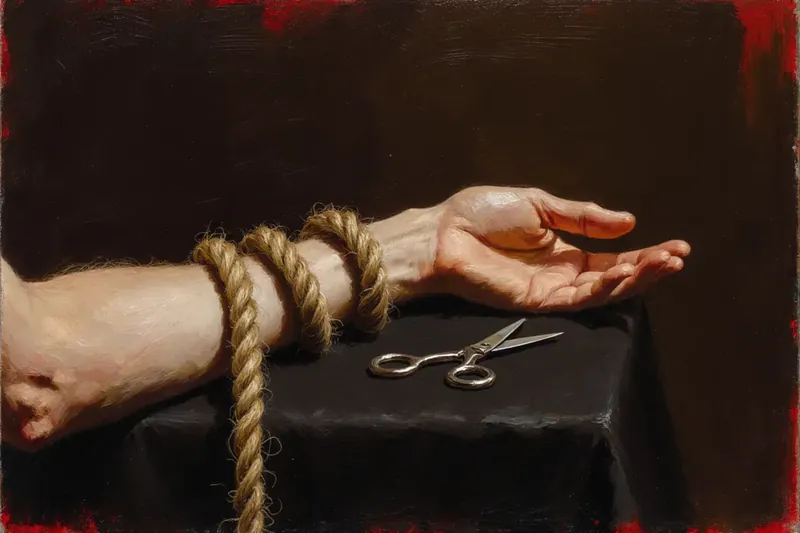
In this chapter
A badly placed rope does not necessarily hurt. That is what makes it treacherous: a compressed nerve can give way suddenly, and the damage is already done by the time anyone notices1. This page contains no knots and no suspension technique. It is there to help you know where to look, what to ask and when to untie, and it applies to any kind of tying, from a scarf knotted around the wrists to shibari, Japanese-inspired rope bondage.
Risk areas
A nerve is vulnerable where it runs close to the skin, against a bone, with no muscle to cushion it. Five areas come up again and again in the medical literature and in practice guides.
| Area | What runs there | What you notice if it gets pinched |
|---|---|---|
| Middle third of the upper arm, at the back (radial groove) | Radial nerve, pressed against the bone2 | Wrist and fingers that drop, reduced sensation on the back of the hand2 |
| Armpit | Brachial plexus, the bundle of nerves that runs down into the arm1, and axillary nerve2 | Weakness in the shoulder and arm, an arm that can no longer be lifted away from the body2 |
| Inner side of the elbow, where a knock sends an electric jolt | Ulnar nerve, very close to the surface at this point3 | Tingling in the ring and little fingers, fingers that are hard to spread3 |
| Head of the fibula, the bony bump on the outside of the leg, just below the knee | Common fibular nerve4 | A foot that drops and catches on the ground, tripping4 |
| Crease of the groin | Femoral nerve2 | Loss of sensation at the front of the thigh, an unstable knee2 |
Two further points. A nerve compressed in the arm often produces its symptoms in the hand: it is the hand you need to watch, not only the spot where the rope runs1. And the wrist matters too: in the hollow between the wrist bones and the hand, veins and nerves lie just beneath the skin1.
What the Khodulev et al. study shows
In 2023, a team of neurologists published in Cureus a series of ten people injured during rope sessions, with sixteen nerve injuries in total2. The radial nerve was affected in nine people out of ten, or 90%. With one exception, all the injuries appeared during or just after a full-body suspension. The other nerves affected were the axillary nerve (shoulder), the femoral nerve (groin) and, in one person, the brachial plexus on both sides after a jolt.
The most detailed case is that of a 29-year-old woman, suspended for 25 minutes with a 6 mm jute rope. The result: wrist and finger drop on the left, reduced sensation in the hand. Some improvement came after three months, full recovery after five. Seventeen months later, a suspension lasting 8 to 10 minutes compressed both her radial nerves again, and it took four weeks to recover. A short duration is therefore not enough to protect a nerve, especially one that has already been affected.
The limitations are real: a small sample, recruitment through four riggers, the people who do the tying, memories reported after the event2. The study tells you where to look. It does not tell you how many sessions go by without any problem.
Warning signs
What should trigger an immediate check: tingling, numbness, loss of strength, sharp “electric” pain2, cold skin or skin of an unusual colour.
Two causes produce tingling: circulation and a nerve. A useful rule of thumb, though not an infallible one: when it is circulation, the whole hand or the whole limb is affected, and it passes almost as soon as the person is untied; when it is a nerve, only part of the hand tingles1. A classic trap: a hand that is entirely numb because of circulation can mask a nerve problem1. When in doubt, untie.
Quick checks during the session
Do them once before tying, to have a baseline, then regularly, comparing both sides:
- squeeze the other person’s hands, both at the same time: the strength should be equal1;
- spread the fingers out like a fan, then bring them back together (ulnar nerve)3;
- lift the wrist, or push with the back of the hand against the other person’s hand (radial nerve). This check matters, because you can squeeze normally and still have an affected radial nerve1;
- lightly brush the back of the hand to check that sensation is the same all over1;
- for the legs, lift the tip of the foot (fibular nerve)4.
Replace “are you OK?” with precise questions: “Can you feel all your fingers? Which ones are tingling?” The person who is tied is not always best placed to judge: a pilot study of 14 people measured, in those on the receiving end, lower performance on an attention test after the scene5. A vague question easily gets a “yes”.
If a sign appears
Untie, right away, starting with whatever is compressing the area concerned. If the knot will not give or the person panics, cut: that is what the shears are for. Do not wait for it “to pass”: nerve injuries often occur suddenly, and they can add up from one session to the next1.
Once the person is untied, repeat the checks. If strength or sensation does not come back fully, see a doctor. The Rope Bottom Guide, a safety guide written for people who are tied, sets a limit: if symptoms last beyond two hours, go to the emergency department or see a doctor1. Nothing stops you going sooner. Write down what happened (position, duration, area): it helps the doctor, and the next negotiation. After an injury, the same guide recommends not placing rope on that area for six months1.
Equipment
A rope made for bondage rather than a hardware-shop rope, and not too thin: a thin rope concentrates the pressure on a small surface. That said, no rope protects against poor placement. The 6 mm jute in the case described above is a common material.
Round-tipped safety shears stay within reach of the person tying throughout the session, not in a bag. Test them on your rope beforehand. Some riggers prefer to untie methodically rather than cut a panicking person free; both approaches are open to debate, but the shears must be there, and should only be used in an emergency so that they stay sharp1.
Floor or suspension
On the floor, the body rests on the floor: the rope holds, it does not carry. In suspension, the rope carries all or part of the weight over small surfaces, and positions change quickly. Almost all the injuries in the Khodulev study occurred in suspension2.
Suspension multiplies the risk. You do not learn it from a website, or from a video: you learn it in person, with someone experienced who corrects your placements on a real body.
That does not make the floor risk-free. An elbow that stays bent or leaned on for a long time can compress the ulnar nerve6; crossed legs or prolonged pressure on the outside of the knee can be enough to affect the fibular nerve4. You do not need to be in the air to get hurt.
Stress positions and duration
Arms behind the back, arms raised, weight on a single point: these positions put strain on the shoulders and the nerves. There is no universally safe duration. In the case described above, 25 minutes cost five months of recovery, and 8 to 10 minutes cost four weeks2. Keep it shorter when the position is demanding, change position before discomfort sets in, and bear in mind that cold and hunger reduce tolerance1.
Communicating during the session
It all starts beforehand. Sensitive areas, old injuries, a stop signal, a non-verbal signal if speech is prevented: the shibari questionnaire is there to set all of this out. During the session, the person who is tied speaks up early, without waiting to be sure. The person tying watches the hands, the colour of the skin and the breathing, and asks precise questions. The Rope Bottom Guide sums it up: the earlier a problem is flagged, the better the outcome1. Nobody earns points for “holding out”.
After the session
Normal: red rope marks that fade, bruises if you had talked about them, tiredness, sometimes emotions coming back up. Not normal: an area that stays numb, a wrist or foot that weakens, sharp pain along a limb, an open friction burn, swelling that keeps increasing. Repeat the checks in the evening and the next day.
If something went wrong, or if you need to talk about it, the Resources page presents RopeHelp, a volunteer point of contact from the Swiss bondage scene, with an FAQ in French. It also lists resources for learning: Rope365, part of which is available in French under the name Corde365, and Shibari Study, in English.
Going further
- Shibari questionnaire: negotiating a rope session, sensitive areas and signals included.
- Equipment: the basic shibari kit, from rope to safety shears.
- Resources: RopeHelp, in-person practice groups, Rope365, Shibari Study and the French version of the Rope Bottom Guide.
- Safety: the general principles, other practices and emergency numbers.
- Body: what the body goes through during and after a scene, aftercare and drop included.
Sources
-
Clover, 2020. The Rope Bottom Guide, French version (translated by Docvale), v4.2. Self-published. link ↑↑↑↑↑↑↑↑↑↑↑↑↑↑↑
-
Khodulev, V., Klimko, A., Charnenka, N., Zharko, M. and Khoduleva, H., 2023. Acute Radial Compressive Neuropathy: The Most Common Injury Induced by Japanese Rope Bondage. Cureus, 15(5), e39588. link ↑↑↑↑↑↑↑↑↑↑↑
-
Chauhan, M., Anand, P. and Das, J. M., 2023. Cubital Tunnel Syndrome. StatPearls, NCBI Bookshelf. link ↑↑↑
-
Thatte, H. and De Jesus, O., 2023. Electrodiagnostic Evaluation of Peroneal Neuropathy. StatPearls, NCBI Bookshelf. link ↑↑↑↑
-
Ambler, J. K., Lee, E. M., Klement, K. R., Loewald, T., Comber, E. M., Hanson, S. A., Cutler, B., Cutler, N. and Sagarin, B. J., 2017. Consensual BDSM facilitates role-specific altered states of consciousness: A preliminary study. Psychology of Consciousness: Theory, Research, and Practice, 4(1), 75-91. link ↑
-
American Academy of Orthopaedic Surgeons, n.d. Ulnar Nerve Entrapment at the Elbow (Cubital Tunnel Syndrome). OrthoInfo. link ↑